
by Rachel Bisaillon
Some of the kids’ names in this post have been changed to remain confidential.
 This month, marks three years at Kastl Rock Ranch. This occasion has me reflecting on how Square Peg has grown and evolved. What it really comes down to is the ability to increase our HorseBoy™ teachings and focus on using humor, nature, and relinquishing control helping create a recipe for success at Square Peg.

Through the eucalyptus trees, small ripples in the pond, and mountainous terrain of our 110 acre farm—I hand over control and leadership to Axel. Some weeks we are gorillas, some weeks dogs, some weeks horses— it’s up to him. We hike the farthest boundary fences of the farm, up the steepest hills and through miles of forest. Every week is an adventure, with Axel leading the way. We run through the underground culvert, a sensory palace. We scramble through the trees and climb fences. Some moments are teachable, some moments are humorous— all experiences are learning moments for me.

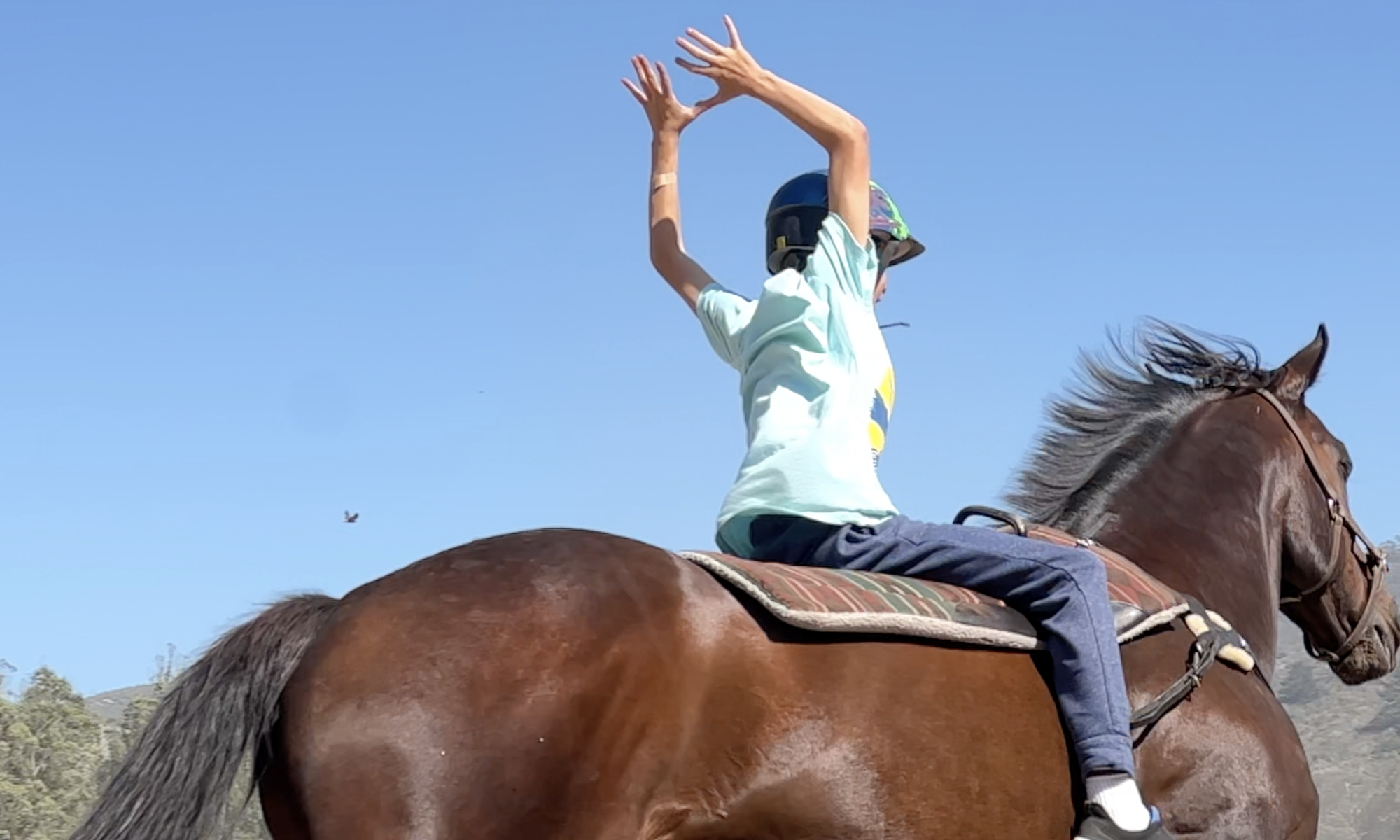
The first time Jimmy arrived at Square Peg, we thought he would never come back. He screamed, pulled hair, pinched, and refused to acknowledge Panzur. He stood at the car banging the hood and screaming for his iPod. We managed to get him in the golf cart which we drove around the arena with Panzur following and eating carrots out of the back. The second time Jimmy came, he threw a carrot at Panzur—acknowledgement! Progress! By the fifth time, Jimmy was riding by himself, with the iPod, watching the Spirit movie. We back-rode for a few sessions and built a relationship of trust. He is now trotting on Panz independently.
 Jay is terrified of dogs. Jay started with us the summer of 2015 and refused to be within five feet of any dog. We carried him, would lock the dogs away, and used the golf-cart to scuttle away from them. We never made a big deal about it, except for showing him these dogs wouldn’t hurt him—they were gentle dogs. We wondered if this would be a forever hatred. Last week, while rocking back and forth on the gate, just above Patti’s floppy ears. He started calling to her, then (surprisingly) launched himself off the gate, ran over, grabbed her wrinkles in fistfuls and got nose to nose with her. “Patttttiiiiiiii, Pattttttttttttiiiiiiiiiii,” he sang. He sat on the ground and snuggled her, while talking about what breed of dog Patti is, where she came from, and how sweet she was.
 Why these three stories? One of the aspects of Horse Boy Method is “Follow the Child.” We’re taught that teaching and learning are about one person having knowledge and bestowing it upon others. It’s the same dynamic from teacher to pupil, from older to younger siblings, doctor to patient, and so on. Letting go long enough to “Follow the Child” takes practice, patience and a whole lot of ego management. But when we do – the whole world changes. It’s only when we are curious and open to learning that we tune in to our physical bodies and the world around us that we actually learn.
Special needs children spend most of their lives in a position of powerlessness:
“Don’t touch that”
“Don’t bother that lady”
“You must eat this, wear this, pay attention to this.”
 When we create an environment where these kids explore, experience and lead us— communication starts to flow from a place of trust. By letting the child lead we we honor his humanity and the wisdom of childhood. Consequently, we learn and we rediscover joy and curiosity.
Take a few hours to follow—live in the shoes of Axel, Jimmy, and Jay for a bit. Be okay with handing over your teacher hat and just playing follower. See where they take you, what they tell you, and how they teach you. It’s a gift.

 have fancy curriculums, beautiful buildings, impressive boards and sponsors.
 It’s what makes a difference. At the end of the day – skills are skills – but values change the way we see ourselves and how we see the world.
 I have a love-hate relationship with labels. Labels such as “special needs” or “autism spectrum disorder” can open doors, spark compassion, and create community. But they can also change how you view a person. Knowing how someone is labeled can provide a false sense that you know what makes him tick, know her strengths, understand his limitations. Labels have an insidious way of blinding you to the individual. And it doesn’t just affect people outside the family. In order to be effective advocates within the school system, parents have to spend a lot of time focused on their child’s diagnosis and areas of need within the educational environment. As a result, our vision can become clouded and we can lose sight of our child’s often considerable strengths.


 Perseverance and patience. That was all it took.
 by Laurel Mitton
 original herd of seven, we had only one retired Quarter Horse left. A barn with 20 horses sounded like heaven. Even so, I was still nervous. I hadn’t ever worked in a real barn and I didn’t know how to handle thoroughbreds. I didn’t know what would happen next.

 aggressive.
 Since that day, Patti has been much friendlier towards me.
 entrusting her to Square Peg.


 by Rebecca Knopf
 beauty I am surrounded by, as well as the joy that emanates from each person when they jump out of their car and walk, run, or wheel into the barn aisle offering goodies, giggles, and pats to each horse they pass.

 Yesterday, Beany was sick and Rachel and I divided up her teaching commitments. I taught C – a barely verbal young man whom I hadn’t worked with before.


 My horse, Panzur, and I have both found a home at Square Peg, even though at first glance, we don’t seem like square pegs at all. Unlike many of Square Peg’s horses, Panzur was never worked hard on the racetrack and then discarded to an uncertain fate at the end of his career. Instead, he has spent his life in fancy show barns, being braided, groomed, acupunctured, and trailered to shows, where he was expected to carry a series of 100-pound teenage girls around jumping courses and then fed excessive amounts of carrots by said teenage girls. While many of Square Peg’s humans spent or are currently spending their childhoods struggling to fit into a school system that doesn’t understand them, I grew up excelling in prep schools and then at Stanford University. While most Square Peg humans view riding simple figures, or even getting up on a horse, to be a challenge, I spent my childhood competing in equitation classes and captaining the Stanford polo team.
  Panzur and I had nowhere to turn, until we found Square Peg. At Square Peg, Panzur found a home where he isn’t just living out his days alone in a pasture, but he gets to use his unique talent for love, affection, and understanding to help people. The rambunctiousness that prevented him from finding a home is miraculously gone – it’s as if Panzur senses that he is carrying people who need to gain comfort and confidence through riding, and he humbly undertakes this important responsibility.